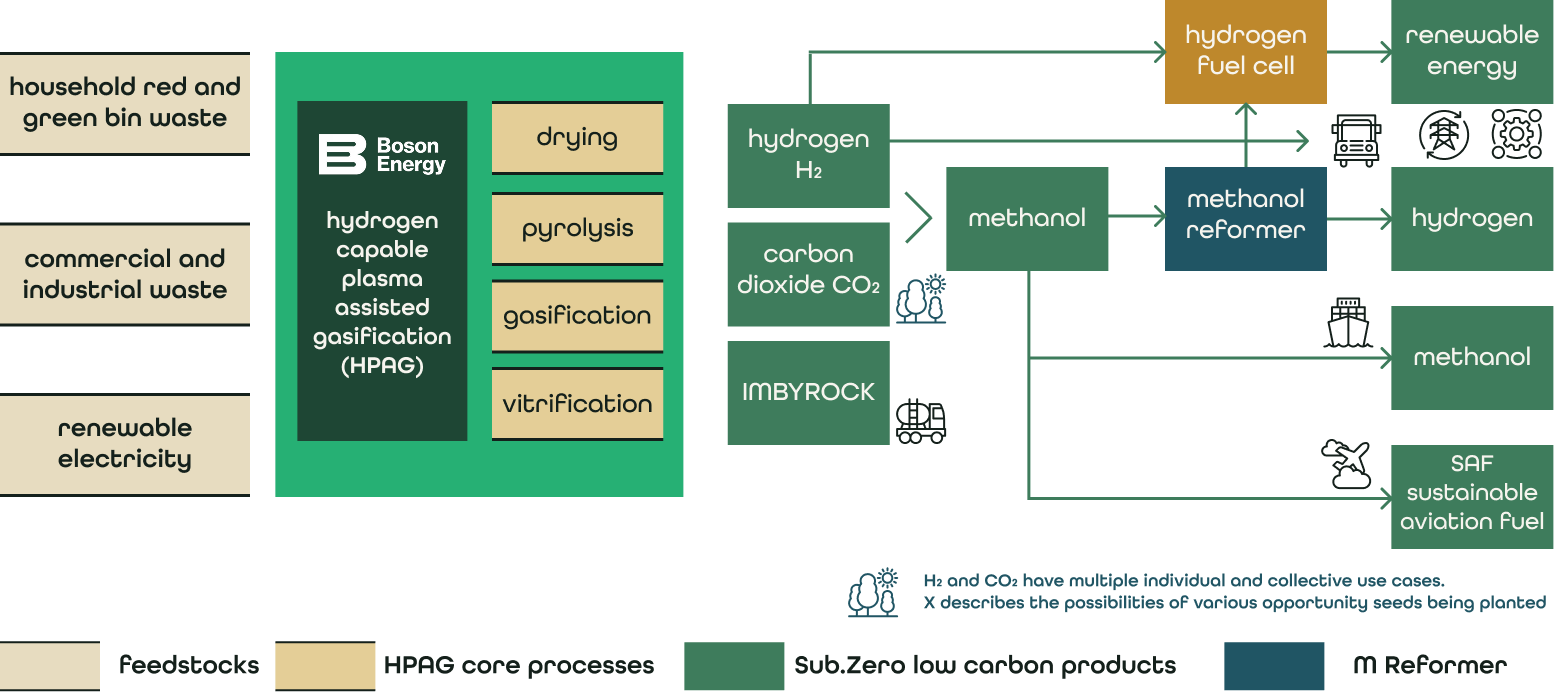
We produce a suite of zero emissions resources, available locally

Redesign.

What a Green Corridor is.

Metrics from upcycling 150,000 tpa waste in Gippsland, Victoria

Sub.Zero methanol a year produced

48,000 tons

Sub.Zero hydrogen upcycled from waste

15 million kg

in Australian economic benefits over 25 years

$3 billion

diesel displaced in road freight transport

80 million litres

CO2e avoided over 25 years - fuel and waste

8.2 million tons

CO2e avoided over 25 years - fuel and waste

xxx

Zero waste from 150,000 tons of waste recycled each year

Fuel and job security. 130+ new long term jobs. Locally made fuels to supply 2,000 to 4,000 trucks or buses

Proven technologies to manufacture Sub.Zero fuels made from upcycling local waste

Captured Sub.Zero CO2 and certified Sub.Zero emission attribute certificates sold alongside the Sub.Zero fuels

Future potential to grow the Precinct’s production capacity to 192,000 tons of Sub.Zero methanol each year

Built to repeat.

Australians bury around 22 million tons of upcyclable waste per year. When upcycled, that’s enough Sub.Zero fuel to displace 36% of Australia’s diesel fuel consumption as low carbon fuels, leading to a 16% pa reduction in CO2e emissions.

Join us. We are opening conversations with climate infrastructure investors, off take backers and public capital partners on our journey.

Zero emissions hydrogen

Zero emissions Grade A+ hydrogen is produced locally utilising renewable power and Hydrogen by Plasma Assisted Gasification (HPAG) technology upcycling otherwise non-recyclable waste away from landfill.

Hydrogen is available to produce renewable power on site or to fuel or charge Zero Emission Vehicles (ZEV) at suitable spaced Sub.Zero refuelling stations. Below net zero, climate positive, hydrogen outcomes are delivered through limiting the up and downstream supply linkages and energy losses in the hydrogen value chain.

Illustratively, we estimate the hydrogen carbon intensity from production, or “Well to Gate”, at negative 10.0 kg CO2e per kg of hydrogen.

All this combines to enable cost effective, Grade A+ hydrogen to be produced, delivered and used locally with today’s technology.

Zero emissions hydrogen

Low carbon methanol

All carbon emissions produced by the HPAG process are captured. Typically, municipal solid waste streams are greater contain greater than 75% organic material, resulting in low carbon content carbon dioxide products.

Low carbon methanol is produced from combining the hydrogen and carbon dioxide. This can be used in a number of ways:

  • to efficiently transport the hydrogen to Sub.Zero hydrogen dispensing stations,

  • for ships as a replacement for heavy fuel oils, or

  • in producing Sustainable Aviation Fuels (SAF) in aircrafts.

Methanol as the preferred hydrogen carrier is simple, available now, easily stored, and transportable as a liquid. It has the highest efficiency and hydrogen to carbon ratio of liquid fuels combined with the lowest CO2e and $/MJ impacts.

Combined, this results in minimal truck movements to transport the hydrogen to nearby where it is to be used.

Illustratively, we estimate the hydrogen carbon intensity from distribution, or “Gate to Point”, at 1.8 kg CO2e per kg of hydrogen.

Renewable power

Utilising renewable power in an efficient and effective way to locally produce and distribute a range of low carbon products (Sub.Zero) that will play a critical role in accelerating our climate transition towards net zero.

Low carbon and zero emission resources that are available to hard to abate sectors are essential.

Grade A+ hydrogen that also doubles to provide locally sourced on demand grid power, micro-grid capacity, fast charging power to vehicles and balance to the grid.

Utilising low carbon methanol, renewable power is capable to be stored and consumed when it is needed acts to destress the upgrades of our electricity infrastructure.

Renewable power

IMBYROCK®

Closing the loop with IMBYROCK® is an important part of Boson Energy’s ‘no waste left behind’ technology. Solids are vitrified into IMBYROCK® construction material. This ready-to-use material represents some 1% to 3% of the volume and 10% of the weight of the waste feed and has been independently confirmed for environmentally friendly use as a construction substitute material.

HPAG delivers a distinct environmental advantage over conventional waste incineration that produces ash of between 25% to 30% of the original weight of the waste.

Boson Energy foresees further upcycling of the IMBYROCK® glass material into a wide range of higher value products.

IMBYROCK

Rethink Zero

Rethink Zero targets Zero Waste to hydrogen and electrifying the home with solar. Beyond electrifying your home with affordable solar electricity, we are encouraging local councils to buy your excess household solar power as a pathway to provide you with lower council rates, cheaper real zero public transport, reasonably priced zero emission freight trucks on our roads, and to simplify our collective journey to zero waste.

Rewiring Australia outlines the case to Electrify Everything in our homes in relation to energy use at home and our private travel.

Boosting the Rewiring Australia model, this pathway provides those residents participating in the plan with higher returns to lower their overall household running costs. Using local infrastructure reduces the biodiversity impacts, energy losses, and costs of constructing renewable energy facilities at long distances.

Local council’s greenhouse gas emissions are typically from waste, energy, transport, and construction projects. Climate positive outcomes are attainable by local councils that progress with wholly or partially owned hydrogen from waste facilities. 

Capturing the hydrogen value from waste, with less renewable energy, less land usage, and greater carbon abatement benefits than known alternative technologies including landfill capture, incineration, electrolysis hydrogen, and composting.