
We reimagine, redesign and rethink waste and ANZ fuel sovereignty
Reimagine.
Imagine your town running with zero waste, clean air, local jobs and zero emission transport. That’s our circular promise. Here’s how Xseed makes it happen…
Australians and Kiwis bury millions of tonnes of waste it doesn’t recycle. Increasingly we pay more to bury it. We also import almost all its liquid fuels, and pay for that too. For diesel, at a price now heading past $3 per litre.

The usual answers don’t reach far enough. Incineration just burns the waste, often recovering less than 10% of its value. Hydrogen by electrolysis is costly given its relatively high energy and water demands.

There’s a better path: take the waste we already pay to bury and recycle it, not burn it, into Sub.Zero methanol. A low carbon fuel you can store, ship and use today, in the sectors with nowhere else to go.

Building renewable energy grid capacity is costly and challenging. So, battery electric mobility works for short, back to base runs, but not for ships, planes, trains and long haul fleets that move the economy.

Methanol is versatile. Hydrogen is the engine inside the process; the methanol is reformed back to hydrogen only where it genuinely earns its place. Made here, from local waste, for local use and export.

Don’t waste the waste.
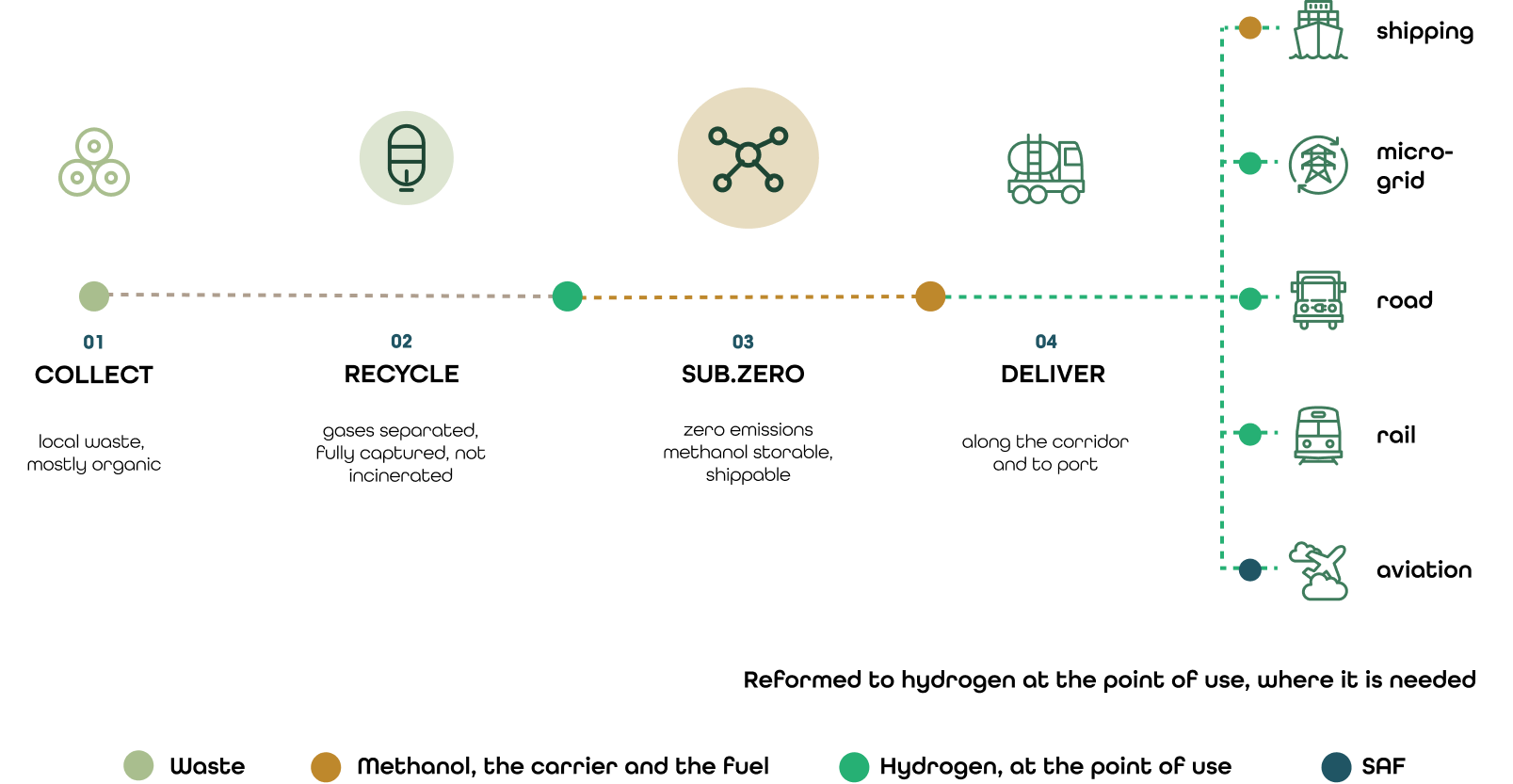
We recycle your waste into Sub.Zero methanol and deliver it as Sub.Zero hydrogen or power along transport Green Corridors.

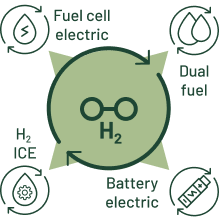
Vehicle owners can refuel trucks or buses across different powertrains and use cases.

battery electric
fuel cell electric
hydrogen dual fuel
hydrogen ICE
Micro-grid power users like AI data centres and remote homes can transition from diesel generators.
Flexibility of supply to preferred zero or low emission vehicle powertrain choices. All this enabling owners to cut diesel use and emissions from 2029.

Upcycling
Hydrogen represents one of the cleanest most versatile future facing energy sources. Hydrogen facilitates a diverse range of products including industrial materials, fertiliser, fuel and in power generation. Upcycling enables affordable solutions for carbon abatement and transition to non-fossil fuel economies.
We provide the following upcycling benefits:
Low carbon impact renewable power
Recycling landfill waste into low carbon fuels
Utilising low carbon methanol as an efficient hydrogen carrier
Delivering zero emissions Grade A hydrogen
Producing low carbon methanol to decarbonise rail, sea and air transport vehicles


Scalable product led economics
Each of our technology solutions is modular and scalable across multiple dimensions.
Whether it is to match your other resource recycling strategies, your demand aspirations for the products produced, or your local community size.
Upcycling and dispensing units are able to be incrementally added to suit your circumstances.
A Precinct’s comparatively small plant footprint, positive environmental impacts and limited inter-dependencies requiring limited water and land provides maximum optionality for site locations.
Whether that is nearby to your existing resource recycling centre, landfill site, power transmission or electricity distribution infrastructure, existing pipelines, local refuelling station, or transport routes.
Breakthrough, innovative sustainability solutions
Lowers cost of waste management for communities by recycling waste into a valuable resource
Enables actionable solutions for governments at all levels for its’ fuel security, cost of living relief, waste, energy, climate transition, organics and low carbon fuels strategies
Scalable 24/7 renewable energy, grid or fast charging EV, firming power generation, produced nearby to enhance live locally ideals
Expandable, flexible, modular solutions with capability to economically ramp to match hydrogen demand
Proven technology that enables transport green corridors with cost effective transport, resolving hydrogen production and delivery issues
Integration of renewables, waste and energy frameworks provides over 5 times more hydrogen potential than alternative technology combinations
Aligns with ambitions to recycle organics and increase recycling rates targets, all enablers to lower waste to landfill needs